
.webp)


Every major shift in commerce starts the same way: with a change in behavior that existing infrastructure can’t quite support yet.
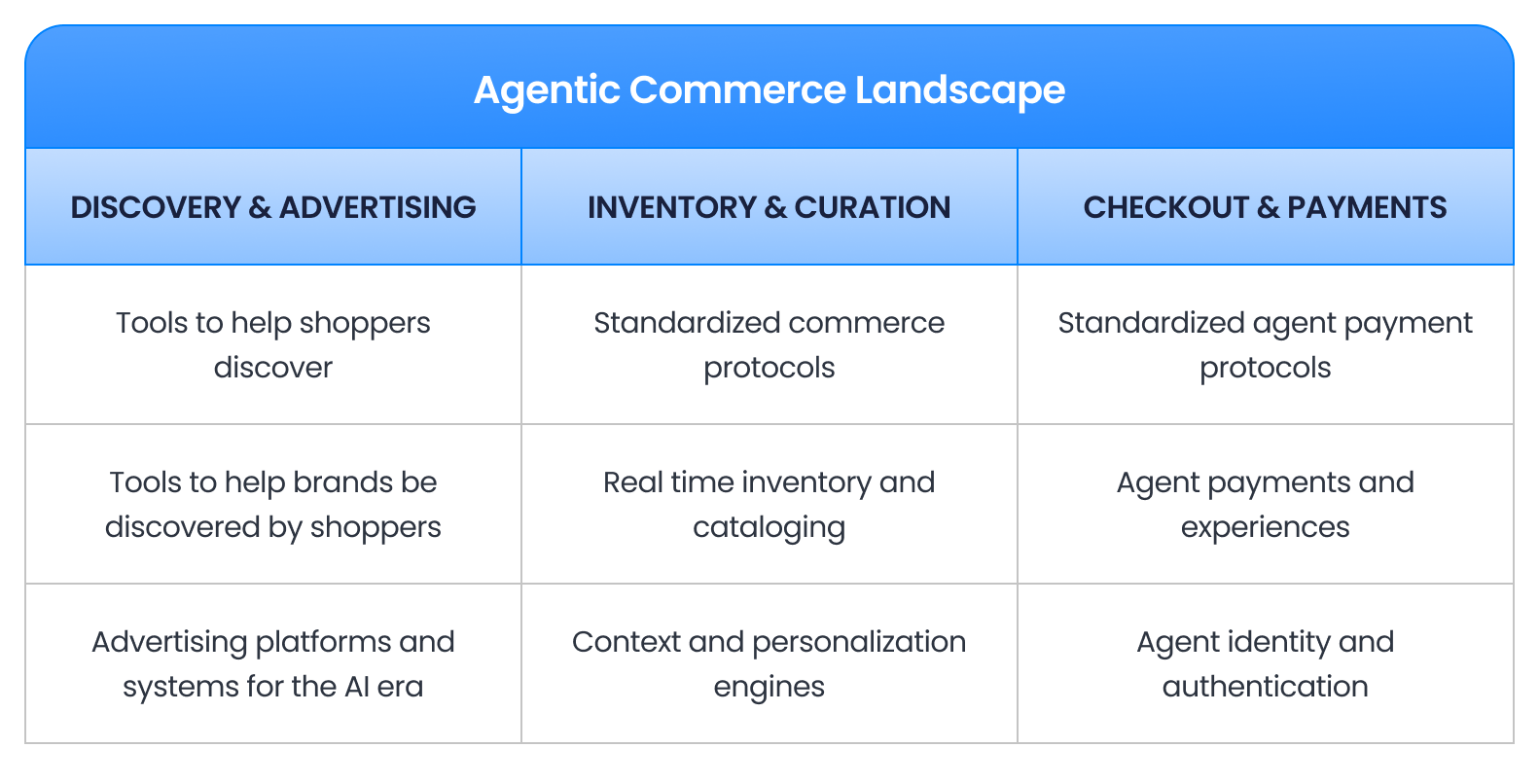
In the early 2000s, when consumers first began shopping online in meaningful numbers, the internet didn’t just need stores, it needed rails to complete the shopping journey end to end. New companies emerged to solve three fundamental problems:
- Discovery & advertising: digital marketing allowed consumers to find products in an online world.
- Inventory & curation: product detail pages (PDP), order management systems (OMS) and other digital storage capabilities allowed products to be organized, cataloged, and made legible on a digital screen.
- Checkout & payments: online payment gateways, APIs and other digital banking technology allowed trust, money movement, and fulfillment to move online.
Those rails didn’t just enable ecommerce, they defined it. And over the next two decades, trillions of dollars flowed across them as continuous improvements were made.
We believe we are now at the very beginning of a similar transition. This time, the catalyst isn’t the browser or the smartphone, it’s agents. Just as moving from in-person to online transactions required new commerce rails to build on top of, moving from human to agentic transactions requires a brand new set of rails. And the race is on to lay down the tracks.
{{expertise}}
From shopping online to shopping by proxy
Shopping behavior is shifting rapidly. Consumers are using general-purpose LLMs like ChatGPT and Gemini to research products, compare options, and narrow decisions. Today, these assistants are primarily being used for discovery and research only, meaning the final decision remains with the human shopper.
But in the medium-term, what starts as assistance (search, recommendations, comparison), inevitably will move towards delegation. Over time, agents won’t just help you decide, they’ll transact directly, often negotiating and coordinating with other agents in the stack. This will take time, but as agents learn more about user’s preferences, personalization will drastically improve and AI shoppers will complete the full transaction (for some, not all of your shopping needs).

Source: OpenAI.
As new rails emerge to support agentic commerce, we believe value will accrue in two directions. Some incumbents like Shopify, Stripe, Google, Meta, and OpenAI are well positioned to capture meaningful share. They already own ads, distribution, identity, payments, and infrastructure. But every platform shift also creates space for new companies to define the interfaces, protocols, and tooling that make the system actually function. The biggest outcomes often come from those who shape how the new behavior works, not just who plugs into it.
We believe that once again, the opportunity breaks down into three familiar layers: 1) discovery & advertising, 2) inventory & curation, and 3) checkout & payments. The new rails being built will determine how humans and agents transact for years to come.
Discovery and ads in a world of agents
Historically, discovery meant convincing a human primarily through text and visuals. Marketers optimized for keywords, rankings, feeds, social trends and influencers. They shaped perception through ads, storytelling, and repetition. The consumer funnel from awareness → consideration → conversion happened across multiple channels and touch points.
Increasingly, however, discovery is mediated by systems that summarize, rank, and decide before a human ever sees a product. And with AI-first shopping platforms like Dupe, Daydream, and Phia, personalization is getting so good that the discovery funnel is getting condensed to the few items the shopper is most likely to buy. SEO has quickly moved to Answer Engine Optimization (AEO) as players like Profound, Bluefish, Fermat, and Graphite have built platforms to help companies appear first in answers, creating zero-click results.
During the 2025 holiday shopping season, we saw early signs of this shift. AI-driven search and recommendation tools influenced a growing share of purchase consideration, even when the final transaction still happened on a traditional ecommerce site. Traffic from LLMs to merchant websites increased ~700% YoY. For marketers, this is a real shift from experience design to decision design. They will no longer be building a visual user experience to get the shopper from intent to purchase, rather they will be facilitating the decision of an agent through new design tactics.
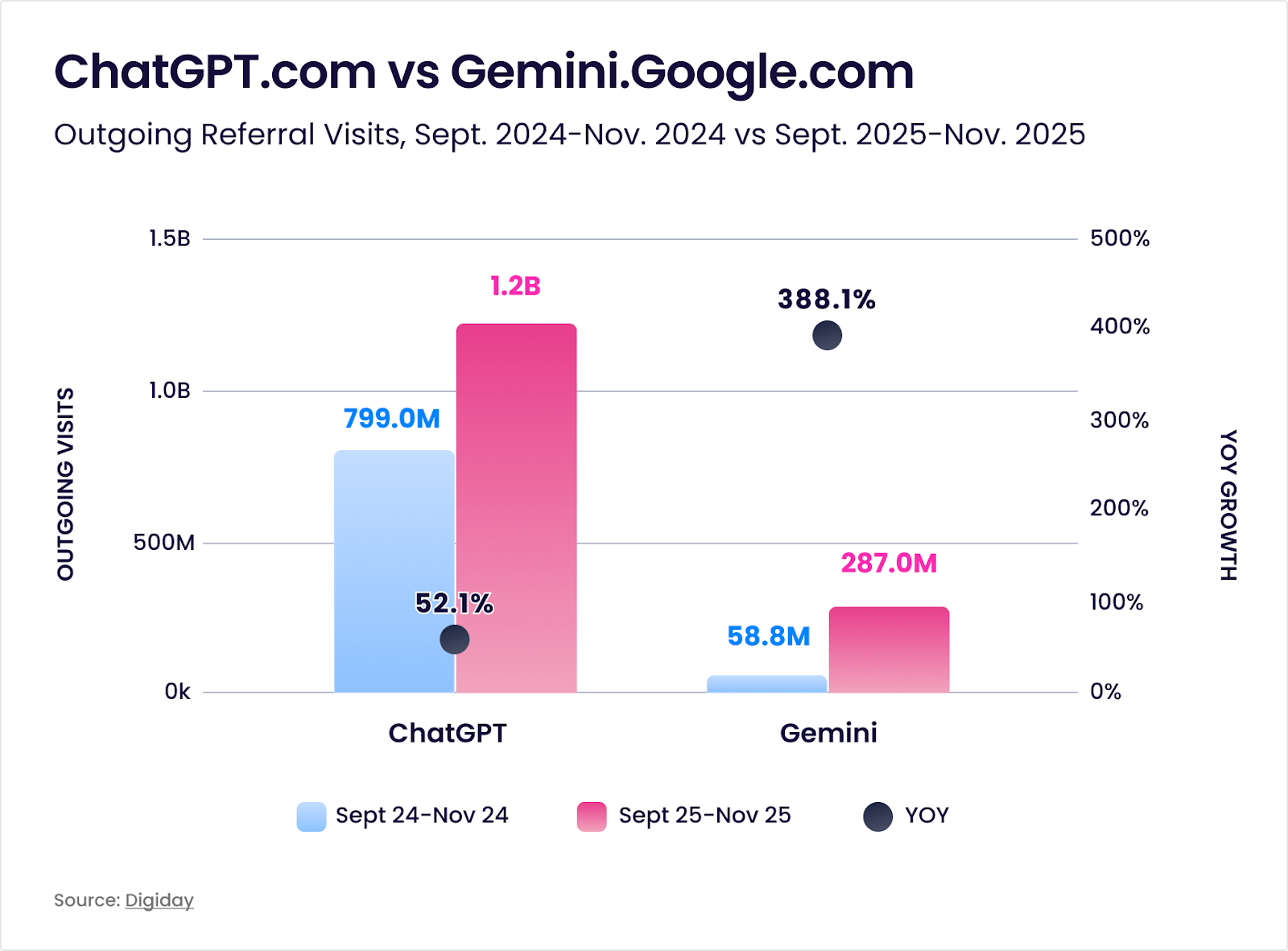
Referral traffic increasing across LLMs. Source: Digiday
Advertising is having its own transformational moment and new rails created. Already close to a $1T market, ads will explode with new contextual capabilities.
As we predicted, ChatGPT is enabling ads and opening up its vast user base to endless advertising possibilities. LLMs have the potential to provide a much better consumer experience with ads given the real-time and contextual nature of the conversations (yes we thought the Anthropic Super Bowl commercial was very funny; and no we do not believe it will age well).
OpenAI in all likelihood is on its way to become one of the world’s largest advertising platforms, alongside Google, Meta, and TikTok. Over time, we expect many AI platforms will turn on paid, AI-native advertising offerings to support their user growth. Companies like Kontext and Koah are building AI-native ad networks for advertisers to place real-time contextual ads inside of LLMs.
The next phase of agentic advertising begins when a large number of agents are acting on behalf of consumers. These agentic shoppers may not respond to emotional persuasion in the same way humans do. Instead, they may optimize for preset constraints, preferences, trust signals, or historical outcomes.
This raises a foundational question: how do you advertise to an agent? Early protocols such as AdCP and ARTF have attempted to standardize how agents buy and sell ads. In the future, advertising could evolve into something more structured – economic incentives, reputation systems, or even agent-to-agent microtransactions that exchange context or intent. For example, if my agent is looking for a new car and interacts with an agent from Tesla, they could exchange information about my preferences as a form of advertising to suggest the best fit for my family.
We suspect advertisers will learn how to market to both humans and agents during the discovery phase. Ads will adapt to influence agents directly, and at the same time, brands will continue to invest in shaping human desire where they can.
Inventory and curation as living systems
If discovery is changing how products are found, inventory and curation are changing how products are understood and made available.
Again, historical context is helpful in understanding why the status quo won’t cut it. Marketers historically have designed visual-based experiences to get human shoppers to purchase. They emphasize imagery, video, copy, and layout. There was no need for a standardized PDP across the web because as long as we saw the product and knew it was in stock, this was enough to purchase.
Agents, by contrast, don’t need any of this. They simply need clarity: availability, pricing, fulfillment constraints, return policies, authorization signals, among others - all in a standardized format that reduces hallucinations. And in an agentic world, static catalogs don’t work. If AI agents are to shop effectively, they need to know what’s out there to buy. This means having access to comprehensive, up-to-date product information across the web – everything from prices and inventory levels to specifications and reviews.
The current commerce rails are lacking. If you’re a power user of shopping on ChatGPT you’ve likely clicked on a link that has led you to a “404 Error” page or broken link. Or similarly frustrating, you’ve clicked on a product that is currently out of stock. This hallucination occurs because the AI is guessing in a world with no standardized rails to search and retrieve real-time product information across the web. The agent could be relying on popular Reddit threads (as LLMs often do) that showed high interactions, but link to a product that is no longer available.
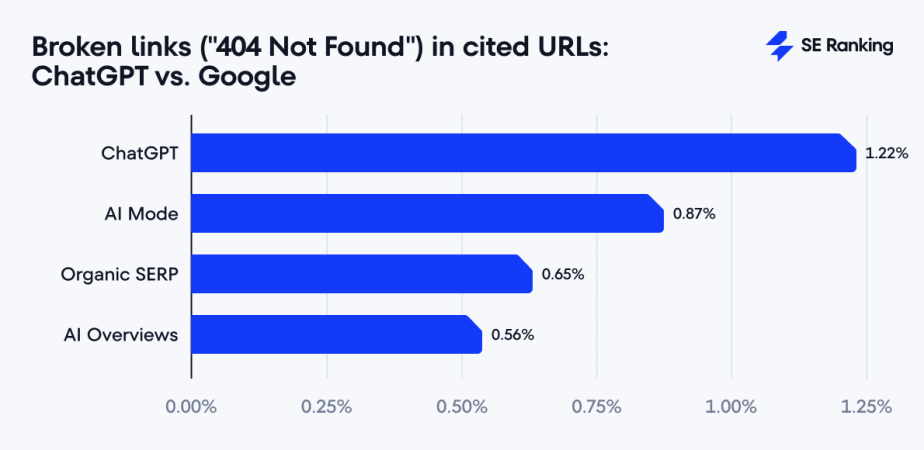
Source: SE Rankings.
This is giving rise to new cataloging and inventory rails for agentic commerce: infrastructure that standardizes and serves up product data to agents, and new approaches to how real-time information on products is gathered. There is a race to lay the new rails to connect AI shoppers with the long-tail of ecomm merchants.
OpenAI’s Agentic Commerce Protocol (ACP) and Google’s Universal Commerce Protocol (UCP) are early attempts to standardize how agents read and interact with commerce data across the web. If successful, they could do for agentic commerce what early APIs did for ecommerce platforms: make the system interoperable.
While these incumbents are laying the early groundwork, they are by no means monopolizing the standardization of the industry. We see ample opportunity for start ups to help define the messy middle of inventory and curation for commerce. Companies like Channel3 and Catalog are doing the heavy lifting of standardizing inventory across the long-tail of ecommerce to eliminate stale inventory feeds. Startups like Velou and ReFiBuy are building agentic-first catalog solutions so brands will show LLM-readable inventory to agentic shoppers. An emerging vertical known as context graphs led by companies like Chord, Spangle and Pietra, provide agents with valuable company context to know how to make decisions with company data.
If more and more shoppers will be leveraging AI, merchants must adopt new rails to get their inventory into the (digital) hands of agents.
Payments, trust, and the right to transact
For agentic commerce to move from experimentation to scale, checkout and payments need to work for both humans and agents operating together.
In the human-first commerce era, payment rails have been laid down and improved upon for years. The API-first approach of Stripe increased the GDP of the internet. Visa and Mastercard’s merchant networks established trust and credibility. Shopify turned every online storefront into a functioning digital cash register. These all had one thing in common: human-in-the-loop purchasing.
In the transition to agentic commerce, most transactions in the near term won’t be fully autonomous. Instead, they’ll sit on a spectrum: agents narrowing options and preparing purchases, humans approving or adjusting them, and sometimes agents completing the transaction end-to-end within predefined constraints. Supporting this hybrid reality requires new payment rails and experiences that handle both human and agent-driven flows, while still solving the unique challenges that arise when AI is allowed to buy things.
While incumbents have raced to define early standards, like Google’s AP2 to provide trust and payment protocols for agents, Visa’s Intelligent Commerce to tokenize specific agentic transactions, OpenAI + Stripe’s ACP to allow checkout inside of ChatGPT, and Coinbase’s x402 enabling agentic payments on blockchains, these are early attempts to define standards for agentic payments.
Startups have the opportunity to reimagine new rails built entirely with agents in mind. The more we ask of agents, the more power they will need over making final purchase decisions. Companies like Nekuda, and Payman are building agent-centric payment experiences from the ground up to empower agents to make purchases like humans do - initially permissioning agents with purchasing guidelines, and eventually giving them their own wallets to transact.
Real gaps still exist in the payment rails enabling agentic purchasing. Two of the largest areas for development are identity and liability.
For identity, know-your-agent (KYA) will replace know-your-customer (KYC) to prevent fraud in the agentic era. As more and more transactions occur off of the merchant’s owned website, they will need a way to validate the agent making the purchase is authorized to do so. Scammers already make away with $1T annually, this could exponentially grow in the world of sophisticated agents without the right controls in place. Companies like Skyfire are ensuring agents can prove who they are before they purchase.
For liability, dispute resolution will soon be mission critical as ambiguity in agentic transactions emerges. Take for example an agentic transaction gone wrong: you don’t give your agent specific instructions and it buys the wrong thing. Or worse, you didn’t give permission but the agent interpreted your instructions wrong and bought something. Who’s liable for that transaction? The consumer/agent, the shopping platform, the merchant? Consistently solving for the three-sided puzzle of user intent vs. agent execution vs. merchant expectation is a hard challenge, but it will be necessary for agentic transactions to be trusted.
The longer-term and exciting frontier is building the rails for agents to transact with each other. Protocols and standards will need to be built to allow for things like negotiations, verification, payments, microtransactions and more. This is where crypto could play a larger role - in a world where it’s unclear how agents interact with consumer bank accounts, they may utilize permissioned crypto wallets instead. And with stablecoin rails, the unit economics of microtransactions make much more sense than fiat payments where the processing fee is higher than the actual transaction.
As with earlier waves of commerce, the most valuable companies in this layer won’t just process payments, they’ll define the rules of participation for agents. In a hybrid world of humans and agents shopping together, getting this layer right is what turns agentic commerce from an interesting idea into a scalable reality.
The next wave of commerce
When new rails emerge, they don’t just make old behavior more efficient, they unlock entirely new behavior. And as we’ve seen in the past, extreme value creation emerges. We believe agentic commerce will ultimately drive trillions of dollars in value creation, not just by replacing humans, but by changing how intent moves through the system.
Incumbents have already made the first move in establishing standards and protocols, but the bulk of the new rails are yet to be laid. We see this as the most exciting time in commerce since the early 2000s.
We’re particularly interested in startups building across discovery & advertising, inventory & curation, and checkout & payments – the same categories that defined the last era of commerce, now reimagined for a new one. If you’re building here or in adjacent areas of agentic commerce, we’d love to talk. brent@m13.co and whitney@m13.co
Disclosure: M13 has invested in Kontext, Chord, Pietra and Dupe.
Every major shift in commerce starts the same way: with a change in behavior that existing infrastructure can’t quite support yet.
In the early 2000s, when consumers first began shopping online in meaningful numbers, the internet didn’t just need stores, it needed rails to complete the shopping journey end to end. New companies emerged to solve three fundamental problems:
- Discovery & advertising: digital marketing allowed consumers to find products in an online world.
- Inventory & curation: product detail pages (PDP), order management systems (OMS) and other digital storage capabilities allowed products to be organized, cataloged, and made legible on a digital screen.
- Checkout & payments: online payment gateways, APIs and other digital banking technology allowed trust, money movement, and fulfillment to move online.
Those rails didn’t just enable ecommerce, they defined it. And over the next two decades, trillions of dollars flowed across them as continuous improvements were made.
We believe we are now at the very beginning of a similar transition. This time, the catalyst isn’t the browser or the smartphone, it’s agents. Just as moving from in-person to online transactions required new commerce rails to build on top of, moving from human to agentic transactions requires a brand new set of rails. And the race is on to lay down the tracks.
{{expertise}}
From shopping online to shopping by proxy
Shopping behavior is shifting rapidly. Consumers are using general-purpose LLMs like ChatGPT and Gemini to research products, compare options, and narrow decisions. Today, these assistants are primarily being used for discovery and research only, meaning the final decision remains with the human shopper.
But in the medium-term, what starts as assistance (search, recommendations, comparison), inevitably will move towards delegation. Over time, agents won’t just help you decide, they’ll transact directly, often negotiating and coordinating with other agents in the stack. This will take time, but as agents learn more about user’s preferences, personalization will drastically improve and AI shoppers will complete the full transaction (for some, not all of your shopping needs).
Source: OpenAI.
As new rails emerge to support agentic commerce, we believe value will accrue in two directions. Some incumbents like Shopify, Stripe, Google, Meta, and OpenAI are well positioned to capture meaningful share. They already own ads, distribution, identity, payments, and infrastructure. But every platform shift also creates space for new companies to define the interfaces, protocols, and tooling that make the system actually function. The biggest outcomes often come from those who shape how the new behavior works, not just who plugs into it.
We believe that once again, the opportunity breaks down into three familiar layers: 1) discovery & advertising, 2) inventory & curation, and 3) checkout & payments. The new rails being built will determine how humans and agents transact for years to come.
Discovery and ads in a world of agents
Historically, discovery meant convincing a human primarily through text and visuals. Marketers optimized for keywords, rankings, feeds, social trends and influencers. They shaped perception through ads, storytelling, and repetition. The consumer funnel from awareness → consideration → conversion happened across multiple channels and touch points.
Increasingly, however, discovery is mediated by systems that summarize, rank, and decide before a human ever sees a product. And with AI-first shopping platforms like Dupe, Daydream, and Phia, personalization is getting so good that the discovery funnel is getting condensed to the few items the shopper is most likely to buy. SEO has quickly moved to Answer Engine Optimization (AEO) as players like Profound, Bluefish, Fermat, and Graphite have built platforms to help companies appear first in answers, creating zero-click results.
During the 2025 holiday shopping season, we saw early signs of this shift. AI-driven search and recommendation tools influenced a growing share of purchase consideration, even when the final transaction still happened on a traditional ecommerce site. Traffic from LLMs to merchant websites increased ~700% YoY. For marketers, this is a real shift from experience design to decision design. They will no longer be building a visual user experience to get the shopper from intent to purchase, rather they will be facilitating the decision of an agent through new design tactics.
Referral traffic increasing across LLMs. Source: Digiday
Advertising is having its own transformational moment and new rails created. Already close to a $1T market, ads will explode with new contextual capabilities.
As we predicted, ChatGPT is enabling ads and opening up its vast user base to endless advertising possibilities. LLMs have the potential to provide a much better consumer experience with ads given the real-time and contextual nature of the conversations (yes we thought the Anthropic Super Bowl commercial was very funny; and no we do not believe it will age well).
OpenAI in all likelihood is on its way to become one of the world’s largest advertising platforms, alongside Google, Meta, and TikTok. Over time, we expect many AI platforms will turn on paid, AI-native advertising offerings to support their user growth. Companies like Kontext and Koah are building AI-native ad networks for advertisers to place real-time contextual ads inside of LLMs.
The next phase of agentic advertising begins when a large number of agents are acting on behalf of consumers. These agentic shoppers may not respond to emotional persuasion in the same way humans do. Instead, they may optimize for preset constraints, preferences, trust signals, or historical outcomes.
This raises a foundational question: how do you advertise to an agent? Early protocols such as AdCP and ARTF have attempted to standardize how agents buy and sell ads. In the future, advertising could evolve into something more structured – economic incentives, reputation systems, or even agent-to-agent microtransactions that exchange context or intent. For example, if my agent is looking for a new car and interacts with an agent from Tesla, they could exchange information about my preferences as a form of advertising to suggest the best fit for my family.
We suspect advertisers will learn how to market to both humans and agents during the discovery phase. Ads will adapt to influence agents directly, and at the same time, brands will continue to invest in shaping human desire where they can.
Inventory and curation as living systems
If discovery is changing how products are found, inventory and curation are changing how products are understood and made available.
Again, historical context is helpful in understanding why the status quo won’t cut it. Marketers historically have designed visual-based experiences to get human shoppers to purchase. They emphasize imagery, video, copy, and layout. There was no need for a standardized PDP across the web because as long as we saw the product and knew it was in stock, this was enough to purchase.
Agents, by contrast, don’t need any of this. They simply need clarity: availability, pricing, fulfillment constraints, return policies, authorization signals, among others - all in a standardized format that reduces hallucinations. And in an agentic world, static catalogs don’t work. If AI agents are to shop effectively, they need to know what’s out there to buy. This means having access to comprehensive, up-to-date product information across the web – everything from prices and inventory levels to specifications and reviews.
The current commerce rails are lacking. If you’re a power user of shopping on ChatGPT you’ve likely clicked on a link that has led you to a “404 Error” page or broken link. Or similarly frustrating, you’ve clicked on a product that is currently out of stock. This hallucination occurs because the AI is guessing in a world with no standardized rails to search and retrieve real-time product information across the web. The agent could be relying on popular Reddit threads (as LLMs often do) that showed high interactions, but link to a product that is no longer available.
Source: SE Rankings.
This is giving rise to new cataloging and inventory rails for agentic commerce: infrastructure that standardizes and serves up product data to agents, and new approaches to how real-time information on products is gathered. There is a race to lay the new rails to connect AI shoppers with the long-tail of ecomm merchants.
OpenAI’s Agentic Commerce Protocol (ACP) and Google’s Universal Commerce Protocol (UCP) are early attempts to standardize how agents read and interact with commerce data across the web. If successful, they could do for agentic commerce what early APIs did for ecommerce platforms: make the system interoperable.
While these incumbents are laying the early groundwork, they are by no means monopolizing the standardization of the industry. We see ample opportunity for start ups to help define the messy middle of inventory and curation for commerce. Companies like Channel3 and Catalog are doing the heavy lifting of standardizing inventory across the long-tail of ecommerce to eliminate stale inventory feeds. Startups like Velou and ReFiBuy are building agentic-first catalog solutions so brands will show LLM-readable inventory to agentic shoppers. An emerging vertical known as context graphs led by companies like Chord, Spangle and Pietra, provide agents with valuable company context to know how to make decisions with company data.
If more and more shoppers will be leveraging AI, merchants must adopt new rails to get their inventory into the (digital) hands of agents.
Payments, trust, and the right to transact
For agentic commerce to move from experimentation to scale, checkout and payments need to work for both humans and agents operating together.
In the human-first commerce era, payment rails have been laid down and improved upon for years. The API-first approach of Stripe increased the GDP of the internet. Visa and Mastercard’s merchant networks established trust and credibility. Shopify turned every online storefront into a functioning digital cash register. These all had one thing in common: human-in-the-loop purchasing.
In the transition to agentic commerce, most transactions in the near term won’t be fully autonomous. Instead, they’ll sit on a spectrum: agents narrowing options and preparing purchases, humans approving or adjusting them, and sometimes agents completing the transaction end-to-end within predefined constraints. Supporting this hybrid reality requires new payment rails and experiences that handle both human and agent-driven flows, while still solving the unique challenges that arise when AI is allowed to buy things.
While incumbents have raced to define early standards, like Google’s AP2 to provide trust and payment protocols for agents, Visa’s Intelligent Commerce to tokenize specific agentic transactions, OpenAI + Stripe’s ACP to allow checkout inside of ChatGPT, and Coinbase’s x402 enabling agentic payments on blockchains, these are early attempts to define standards for agentic payments.
Startups have the opportunity to reimagine new rails built entirely with agents in mind. The more we ask of agents, the more power they will need over making final purchase decisions. Companies like Nekuda, and Payman are building agent-centric payment experiences from the ground up to empower agents to make purchases like humans do - initially permissioning agents with purchasing guidelines, and eventually giving them their own wallets to transact.
Real gaps still exist in the payment rails enabling agentic purchasing. Two of the largest areas for development are identity and liability.
For identity, know-your-agent (KYA) will replace know-your-customer (KYC) to prevent fraud in the agentic era. As more and more transactions occur off of the merchant’s owned website, they will need a way to validate the agent making the purchase is authorized to do so. Scammers already make away with $1T annually, this could exponentially grow in the world of sophisticated agents without the right controls in place. Companies like Skyfire are ensuring agents can prove who they are before they purchase.
For liability, dispute resolution will soon be mission critical as ambiguity in agentic transactions emerges. Take for example an agentic transaction gone wrong: you don’t give your agent specific instructions and it buys the wrong thing. Or worse, you didn’t give permission but the agent interpreted your instructions wrong and bought something. Who’s liable for that transaction? The consumer/agent, the shopping platform, the merchant? Consistently solving for the three-sided puzzle of user intent vs. agent execution vs. merchant expectation is a hard challenge, but it will be necessary for agentic transactions to be trusted.
The longer-term and exciting frontier is building the rails for agents to transact with each other. Protocols and standards will need to be built to allow for things like negotiations, verification, payments, microtransactions and more. This is where crypto could play a larger role - in a world where it’s unclear how agents interact with consumer bank accounts, they may utilize permissioned crypto wallets instead. And with stablecoin rails, the unit economics of microtransactions make much more sense than fiat payments where the processing fee is higher than the actual transaction.
As with earlier waves of commerce, the most valuable companies in this layer won’t just process payments, they’ll define the rules of participation for agents. In a hybrid world of humans and agents shopping together, getting this layer right is what turns agentic commerce from an interesting idea into a scalable reality.
The next wave of commerce
When new rails emerge, they don’t just make old behavior more efficient, they unlock entirely new behavior. And as we’ve seen in the past, extreme value creation emerges. We believe agentic commerce will ultimately drive trillions of dollars in value creation, not just by replacing humans, but by changing how intent moves through the system.
Incumbents have already made the first move in establishing standards and protocols, but the bulk of the new rails are yet to be laid. We see this as the most exciting time in commerce since the early 2000s.
We’re particularly interested in startups building across discovery & advertising, inventory & curation, and checkout & payments – the same categories that defined the last era of commerce, now reimagined for a new one. If you’re building here or in adjacent areas of agentic commerce, we’d love to talk. brent@m13.co and whitney@m13.co
Disclosure: M13 has invested in Kontext, Chord, Pietra and Dupe.
Read more
The views expressed here are those of the individual M13 personnel quoted and are not the views of M13 Holdings Company, LLC (“M13”) or its affiliates. This content is for general informational purposes only and does not and is not intended to constitute legal, business, investment, tax or other advice. You should consult your own advisers as to those matters and should not act or refrain from acting on the basis of this content. This content is not directed to any investors or potential investors, is not an offer or solicitation and may not be used or relied upon in connection with any offer or solicitation with respect to any current or future M13 investment partnership. Past performance is not indicative of future results. Unless otherwise noted, this content is intended to be current only as of the date indicated. Any projections, estimates, forecasts, targets, prospects, and/or opinions expressed in these materials are subject to change without notice and may differ or be contrary to opinions expressed by others. Any investments or portfolio companies mentioned, referred to, or described are not representative of all investments in funds managed by M13, and there can be no assurance that the investments will be profitable or that other investments made in the future will have similar characteristics or results. A list of investments made by funds managed by M13 is available at m13.co/portfolio.